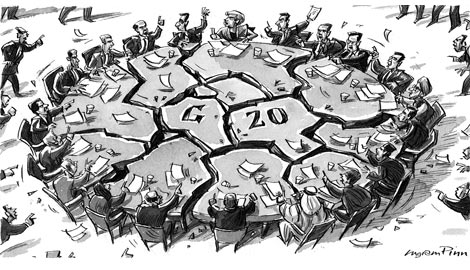
当全球各大国领导人即将齐聚一堂、出席“20国集团”(G20)峰会之际,韩国东道主满怀希冀地把这个组织称作是“全球筹划指导委员会”。但鉴于这么多人在七手八脚地争夺“方向盘”,G20不出重大事故就已属万幸。
雷曼兄弟(Lehman Brothers)破产之后,世界各国领导人立即携起手来。法国总统尼古拉•萨科齐(Nicolas Sarkozy)甚至欢呼:“G20预示着21世纪将是全球治理的时代。”
然而,眼下G20看上去更像是在预示着21世纪将是国际冲突的时代。在大多数问题上,美国和中国是国际关系紧张的焦点,但世界并没有分裂为“亲美”和“亲华”两大阵营。相反,目前共有七大“轴”在划分着世界。
盈余国家与赤字国家:存在高额贸易及经常项目逆差的国家,希望G20讨论全球经济失衡问题。但它们面对的是一个“盈余轴心”(盈余国家联盟),后者对这种行动的必要性持怀疑态度。美国和中国出于这场争论的核心,但在指责美国经济政策、反对采用数字化的经常账户目标方面,德国表现得比中国更加强硬。德国也是一个出口大国。“盈余轴心”的另外两名成员是日本和沙特。
操纵国与被操纵国:美国指责中国有意低估人民币,以此操纵汇率。中国则反驳称,美国印制美钞才是操纵市场。其它G20成员国担心会卷入一场“全球汇率战”。有些国家(尤其是印度)似乎更担心中国人民币汇率低估的问题,而有些国家(如德国)则似乎更担心美联储的举措。但没有一个国家愿意卷入这场纷争。
财政紧缩国与扩张国:两年前,这是G20的一大争论焦点:英美赞成采取赤字支出政策,德国则表示反对。如今,英国已加入紧缩阵营,美国政界也在遏制支出的进一步扩张。因此,目前可能只有国际货币基金组织(IMF)在呼吁全球出台新一轮刺激支出政策。
民主与专制:G20的成员国名单,突显出中国的政治体制是多么异类。花名册上的20个大国中,只有中国和沙特是确然无疑的非民主国家。俄罗斯则介乎于民主与专制之间。不过,G20极少出现民主与专制的分裂——这对中国来说可谓幸事。一定程度上这是因为G20所讨论的问题绝大部分围绕着经济。同时,即使偶尔扯到了政治话题上,也有许多分歧比民主与专制之争更加紧要。
西方与东方:G20的存在,本身就证明全球力量格局已发生了改变。原先的G7本质上是西方白种人的天下,外加上一个日本。而新的G20则包括了昔日被西方列强殖民或击败、如今正在崛起的国家——中国、印度、南非、印尼和巴西。这意味着,情感、认同和种族等相关问题,以及许多更容易分辨的经济政治问题,都在造成着G20的分裂。
当话题转向气候变化时,经济和情感之间错综复杂的交融就变得十分明显。联合国气候谈判失败后,一些人寄望G20或许能够达成一项气候协议。然而,在联合国出现的分裂局面,在G20中又重新上演。中国、印度和巴西指出,温室气体大多是西方工业化国家排放的;西方国家的人均能源消耗量仍远高于发展中国家。美国和欧洲则表示,中国是当今世界第一大温室气体排放国——除非发展中国家一起减排,否则任何协议都不会见效。争论中剑拔弩张、各不相让,最终陷进僵局。
干涉主义与自由放任主义:G20国家面临一个基本哲学问题——是应该寻求具有法律约束力的新协定,还是应该继续按照自愿原则行事?只有在这个问题上,美国和中国倾向于站在同一边(大国比较重视国家主权)。在建立新的国际法律体制的问题上,两国都谨慎地不予赞同。欧盟国家则倾向签署新国际条约,并希望G20有朝一日能够发展成为萨科齐所说的“全球”政府。欧洲人很可能要失望了。
大国与小国:有一种全球划分不能在G20峰会上提及,这便是发生在获邀出席的20个大国与被排除在外的170多个国家之间的划分。联合国和世界银行(World Bank)等机构的到场,部分就是为了补偿那些不能派代表与会的国家。但这些国家正越来越公开地挑战G20要成为“世界筹划指导委员会”的主张。
结论令人沮丧。G20非但不能为世界大多数紧迫问题提供解决方案,反而日益显得分裂、无效及缺乏合法性。
吉迪恩•拉赫曼最近出版了一本新书——《零和世界》(Zero-Sum World)
译者/杨远
http://www.ftchinese.com/story/001035438
As the leaders of the world’s biggest powers gather for a Group of 20 summit, their South Korean hosts talk hopefully of the organisation as a “steering committee of the world”. But there are so many different hands grabbing for the steering wheel that the G20 will be lucky to survive without a serious accident.
In the immediate aftermath of the fall of Lehman Brothers, the world’s leaders pulled together. President Nicolas Sarkozy of France even enthused: “The G20 foreshadows the planetary governance of the 21st century.”
These days, however, the G20 looks more like it is foreshadowing the international conflicts of the 21st century. The central tension on most issues is between the US and China. But the world is not splitting into a pro-American and pro-Chinese camp. Instead, there are now seven main axes that divide the world.
Surplus versus deficit countries: Countries that are running large trade and current account deficits want the G20 to discuss global economic imbalances. But they face an “axis of surplus” that is sceptical about the need for action. America and China are at the heart of the dispute. But Germany, another big exporter, has taken an even harder line than China in criticising American economic policy and rejecting the call for numerical targets for current account deficits. Other members of the axis of surplus are Japan and Saudi Arabia.
Manipulators vs manipulated: America accuses China of manipulating its currency by deliberately undervaluing the renminbi. China retorts that it is America that is manipulating the markets by printing dollars. The rest of the G20 worries about being caught in the crossfire of a global currency war. Some, particularly the Indians, seem more concerned about the Chinese undervaluation. Others, such as the Germans, seem more worried by the actions of the US Federal Reserve. But no one likes being caught in the middle.
Tighteners vs splurgers: Two years ago, this was the big argument at the G20 – as America and Britain argued for deficit spending and Germany resisted. Now Britain has joined the tighteners and US politics constrain any further splurge in American spending. That could leave the International Monetary Fund as the sole voice calling for a new global spending stimulus.
Democracies vs autocracies: The list of G20 countries underlines how anomalous China’s political system now is. Of the 20 big powers around the table, China and Saudi Arabia are the only two unambiguously undemocratic countries – with Russia straddling the democratic-authoritarian divide. But, fortunately for China, the G20 rarely splits along these lines. This is partly because the G20’s agenda is still overwhelmingly economic. It is also because, even when the G20 nations stray on to political issues, there are other divisions that matter more than the one between democracies and autocracies.
West vs the rest: The very existence of the G20 acknowledges that the global balance of power has changed. The old G7 was essentially the white, western world, plus Japan. The new G20 includes rising powers that were once colonised or defeated by western powers – China, India, South Africa, Indonesia, Brazil. That means that the G20 is divided by issues of emotion, identity and race – as well as by more easily defined economic and political issues.
The complex mix between economics and emotion is evident when the discussion turns to climate change. After the failure of the UN talks, some hoped that the G20 might strike a climate deal. In fact, the divisions at the UN are replicated at the G20. The Chinese, Indians and Brazilians point out that the industrialised nations of the west put most of the greenhouse gases into the atmosphere and still consume far more energy per head than developing nations. The Americans and Europeans respond that China is now the largest emitter of greenhouse gases in the world – and that no deal can work, unless the developing world also cuts back. The result is acrimonious deadlock.
Interventionists vs souverainistes: The G20 nations face a fundamental philosophical issue – should they be looking for legally binding new agreements or should they proceed on a voluntary basis? For once, America and China – as big countries that care a lot about national sovereignty – tend to be on the same side. They are both wary of agreeing to new international legal regimes. The countries of the European Union, however, adore new international treaties and were hoping that the G20 might one day develop into the “planetary” government that Mr Sarkozy spoke of. The Europeans are liable to be disappointed.
Big vs small: There is one global divide that cannot be expressed at a G20 summit – and that is the divide between the 20 big countries that have secured invitations and the 170-odd that are excluded. The presence of organisations such as the UN and the World Bank is meant partially to compensate the unrepresented nations. But they are increasingly open in challenging the G20’s pretensions to be a “steering committee for the world”.
The conclusion is dispiriting. Far from being the solution to the world’s most urgent problems, the G20 looks increasingly divided, ineffectual and illegitimate.
Gideon Rachman is author of a new book, Zero-Sum World (Atlantic)


没有评论:
发表评论