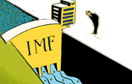
那真的是10多年前才发生的事情吗?当时马来西亚为应对亚洲金融危机开始实行资本管制,国际货币基金组织(IMF)和投资者开始对此咆哮不已。我们之所以这样问,是因为突然之间,那些年代似乎变得如此遥远。如今,在一个又一个国家重新实行资本管制之际,IMF不仅袖手旁观,而且实际上是在鼓励这种做法。那些因这些新的管制措施而被剥夺了自由的投资者呢?他们对海外放贷及投资的热情丝毫没有减弱。这到底是怎么回事?在我们看来,这是过去30年全球金融管理领域最为重大的一场转变。
与多数转变一样,这种改革是渐进性的。实际上,在亚洲金融危机爆发后不久,IMF对资本管制的看法就开始改变了,当时智利、中国和印度等国实行了资本管制。多数分析人士发现,这些资本管制在若干关键方面相当有益。这一成功让IMF软化了其强硬立场:它承认,在特别情况下,只要资本管制是暂时的、对市场友好且严格针对资本流入,那么这些措施或许是可以忍受的。尽管如此,决策者采取资本管制还是有危险的,特别是可能会受到IMF和信用评级机构的谴责,以及国际投资者的惩罚。
在当前危机之前曾经只是涓涓细流的资本管制,现在已成了泛滥的洪水。2008年,冰岛率先采取措施,应对金融内爆。很快,一些发展中国家采取行动:一些国家加强了现有的管制措施,另一些则推出了针对资金流入和流出的新举措。例如,在此次危机期间,中国扩大了该国本已广泛的资本管制措施,而印尼、台湾、秘鲁、阿根廷、厄瓜多尔、乌克兰、俄罗斯和委内瑞拉也推出了这样或那样的管制措施。仅仅在2010年10月一个月:巴西两次上调外资投资固定收益债券的税率,而不对外国直接投资征税;泰国对外资持有政府和国有企业债券的利息收入和资本利得征收15%的预扣税;韩国监管者已开始对利用外汇衍生品的银行进行审计。
IMF并未推动这一改革进程,但针对危机的紧迫性,该机构人员迅速调整了自己的思路。其中一个紧急局面是,许多发展中国家的货币出人意料地升值,这是资金从富裕国家微薄回报抽离的结果。IMF许多最近的报告明确指出,资本管制是政策工具包的正当组成部分。IMF总裁多米尼克•斯特劳斯-卡恩(Dominique Strauss-Kahn)最近在上海的一次演讲中提到了这点,而IMF西半球部门主管对哥伦比亚利用资本管制回应本币快速升值的做法提供了解释(但未成功)。无可否认,这不是昔日的IMF。
当然,资本管制并非一项新的政策措施。二战后,经合组织(OECD)成员国(除美国以外)以及发展中世界都曾普遍使用这项措施,只是在上世纪70年代,随着各国转向新自由主义,该政策才逐渐失宠。与目前的措施相比,当时的一些资本管制措施非常严厉。实际上,在韩国,80年代以前,投资者持有外汇或汇出资金都必须获得政府的批准。
在新自由主义时期被人遗忘的是,通过增强金融稳定,很多这些明显“反市场”的措施帮助推动了快速经济发展。这并不是说,所有的资本管制措施都是成功的,也不是说,所有为实施这些管制而采取的措施都是合适的。然而,这不应使我们忽视其对当时空前经济增长和稳定做出的巨大贡献。
我们当中那些长期支持系统性金融改革的人,兴奋的关注着目前的动态。各国需要实行资本管制的自由,以满足自己的具体需要,让我们感到欣慰的是,在束缚性的新自由主义意识形态长期占据主导地位之后,它们终于获得了这种自由。
然而,转变时期也具有潜在的危险性,因为各国都在各自为失业和不安全问题寻找解决方案,而这些问题需要集体行动。因此,现在我们迫切需要制定一个新的国际金融架构,这种架构既支持国家政策自治,又确保多元化的国家战略相互配合,凝聚成一种互利的协同。让我们期待,20国集团(G20)领导人将在即将召开的首尔峰会上沿着这些方向展开商谈,然后着手建立一个新的国际金融框架,在此过程中更为广泛的接触发展中国家。
伊恩•格拉贝尔在丹佛大学(University of Denver)任教,张夏准执教于剑桥大学(University of Cambridge)。二人合著的著作名为《Reclaiming Development》,张夏准的新书名为《关于资本主义,他们没有告诉你的23件事》(23 Things They Don’t Tell You About Capitalism)
译者/梁艳裳
http://www.ftchinese.com/story/001035210
Was it really just over a decade ago that the International Monetary Fund and investors howled when Malaysia imposed capital controls in response to the Asian financial crisis? We ask because suddenly those times seem so distant. Today, the IMF is not just sitting on its hands as country after country resurrects capital controls, it is actually going so far as to promote their use. What about the investors whose freedoms are eclipsed by the new controls? Well, their enthusiasm for foreign lending and investing has not been damped in the least. So what is going on here? In our view, nothing short of the most significant transformation in global financial management of the past 30 years.
Like most transformations, this reform has been gradual. Reform in the IMF view of capital controls actually began soon after the Asian crisis, as countries such as Chile, China and India imposed controls. Most analysts found that these controls were beneficial in key respects. This success led the IMF to soften its hardline stance: it admitted that controls might be tolerable in exceptional cases provided that they were temporary, market friendly and focused strictly on capital inflows. That said, policymakers adopted capital controls at their peril – not least risking condemnation by the Fund and by credit rating agencies, and punishment by international investors.
What was just a trickle of controls before the current crisis is now a flood. Iceland led the way in 2008 as it grappled with its financial implosion. Soon after, a parade of developing countries took action: some strengthened existing controls while others introduced new measures that targeted inflows and outflows. For example, during the crisis China augmented its extensive array of controls, while Indonesia, Taiwan, Peru, Argentina, Ecuador, Ukraine, Russia and Venezuela also introduced controls of one sort or another. In October 2010 alone: Brazil twice raised its tax on foreign investment in fixed-income bonds while leaving foreign direct investment untaxed; Thailand introduced a 15 per cent withholding tax on capital gains and interest payments on foreign holdings of government and state-owned company bonds; and South Korean regulators have begun to audit lenders utilising foreign currency derivatives.
The IMF did not drive this process of reform, but its staff have adjusted their thinking quickly in response to the exigencies of the crisis. One of these is the unforeseen currency appreciation in many developing countries that is a consequence of capital flight from the dismal returns now on offer in wealthy countries. Many recent Fund reports make clear that capital controls are a legitimate part of the policy toolkit. Dominique Strauss-Kahn, the IMF’s managing director, said as much in his recent speech in Shanghai, while the director of the Fund’s western hemispheric department made a case (unsuccessfully) for the use of controls in Colombia in response to the rapid appreciation of its currency. Not your grandfather’s IMF, to be sure.
Capital controls are not a new policy measure, of course. Instead, they were used universally by members of the Organisation for Economic Co-operation and Development (with the exception of the US) and across the developing world after the second world war, and only fell out of favour with the shift toward neo-liberalism in the 1970s. Some of the capital controls of this period were downright draconian in contrast with current practice. Indeed, in South Korea, investors were required until the 1980s to secure government permission for holding foreign currency or exporting capital.
What was forgotten during the neo-liberal era is that many of these explicitly “anti-market” measures helped to promote rapid economic development by increasing financial stability. This is not to say that all controls were successful or that all measures taken to enforce them were appropriate. That should not, however, distract us from acknowledging their tremendous contributions to unprecedented economic growth and stability during the period.
Those of us who have long advocated systematic financial reform look at current developments with excitement. Countries need the latitude to impose capital controls that meet their particular needs, and it is a relief to see that they are finally getting it after a long period of debilitating neoliberal ideology.
Yet periods of transformation are also potentially dangerous, as countries search individually for solutions to problems of unemployment and insecurity that require collective action. There is, therefore, a pressing need today for a new international financial architecture that at once promotes national policy autonomy, while ensuring that diverse national strategies cohere into mutually beneficial co-ordination. Let us hope that leaders of the Group of 20 economies begin a conversation along these lines at its upcoming meetings in Seoul, and then reach out to the developing world more broadly in a process of building a new international financial framework.
Ilene Grabel teaches at the University of Denver and Ha-Joon Chang at the University of Cambridge. Their joint book is Reclaiming Development. Ha-Joon Chang’s latest book is 23 Things They Don’t Tell You About Capitalism


没有评论:
发表评论